

Pistol Review: Phoenix Arm's Drake
If you have already read about the Phoenix Redback Gen 2 and thought to yourself, "That sounds incredible, but I want more barrel, more mass, and more mechanical accuracy," then allow me to introduce you to the gun that Phoenix built for exactly that impulse. The Drake is the company's larger, heavier, more purpose-built competition pistol, and it represents what happens when a team of Swiss engineers who already made one of the finest CZ-architecture pistols on the planet decided to see how far the platform could actually go.
The answer, as it turns out, is quite far.
--
The Lineage
Phoenix AG traces its roots to the original Sphinx Systems, the Swiss manufacturer responsible for the Sphinx 3000 series of CZ 75-based pistols that earned a cult following among competitive shooters and collectors in the late 1990s and 2000s. After Sphinx was acquired by Kriss and the partnership eventually dissolved, the original owner returned to Interlaken, Switzerland, and founded Phoenix AG. The Redback was the first product, essentially a refined and improved Sphinx 3000. The Drake came next, designed from the outset as a dedicated competition pistol that could cross between IPSC Production, Production Optics, and Standard Minor divisions. In the U.S. market, both pistols are now imported and supported by B&T USA.
Where the Redback is the all-around performer, the Drake is the specialist. It shares much of the Redback's DNA, but the differences are not cosmetic. They are structural, mechanical, and purpose-driven.
What Makes the Drake Different
The most immediately apparent distinction is size. The Drake wears a 5-inch cold hammer forged barrel with polygonal rifling, a full half inch longer than the Redback's 4.55-inch tube. That additional barrel length extends the sight radius, adds a small velocity advantage, and shifts the balance point forward in a way that rewards the deliberate, sight-focused shooting that competition demands.
But the real engineering story is the barrel bushing. The Drake incorporates a Briley-style spherical bushing that guides the barrel into lockup with a level of consistency that a standard CZ-architecture tilt-barrel system simply cannot achieve. Phoenix reportedly used actual Briley bushings during development before engineering their own proprietary version after testing revealed that the Briley units had a service life of roughly 15,000 rounds. The Phoenix bushing is designed for the kind of sustained round counts that competitive shooters put through their guns, and the accuracy benefits are measurable. During factory testing and development, Phoenix documented sub-2-inch groups at 50 meters.
The slide features a lightening cut along the top, which reduces reciprocating mass for faster cycling and quicker return to battery. Combined with the Drake's full-length dust cover rail, which adds static weight to the frame, the result is a pistol that manages recoil by keeping the heavy parts still and making the moving parts lighter. It is the same principle that drives 2011 race gun design, applied here to a CZ-architecture platform with Swiss execution.
Like the Redback, the Drake is built on a two-piece modular frame design, with an upper frame (the rail section) and a lower frame (the grip module), both machined from stainless steel. The slide rides inside the frame on full-length, hand-fitted rails with zero detectable play. The fit between slide and frame is the kind of thing that is difficult to describe in text and impossible to forget once you have felt it. There is no rattle, no shift, no perceptible movement in any axis. It is simply locked together, and it moves like it was machined as a single unit.
The Trigger and Controls
The DA/SA trigger uses Phoenix's tri-angled trigger geometry, which optimizes the leverage relationship between the trigger shoe and the sear throughout the pull. The double-action stroke is smooth and stack-free, transitioning into a defined wall. The single-action break is crisp, light, and virtually free of creep, with a short, audible reset. Overtravel is adjustable via a set screw. Multiple trigger shoe profiles are available through the Phoenix accessories catalog, including flat-faced and curved options.
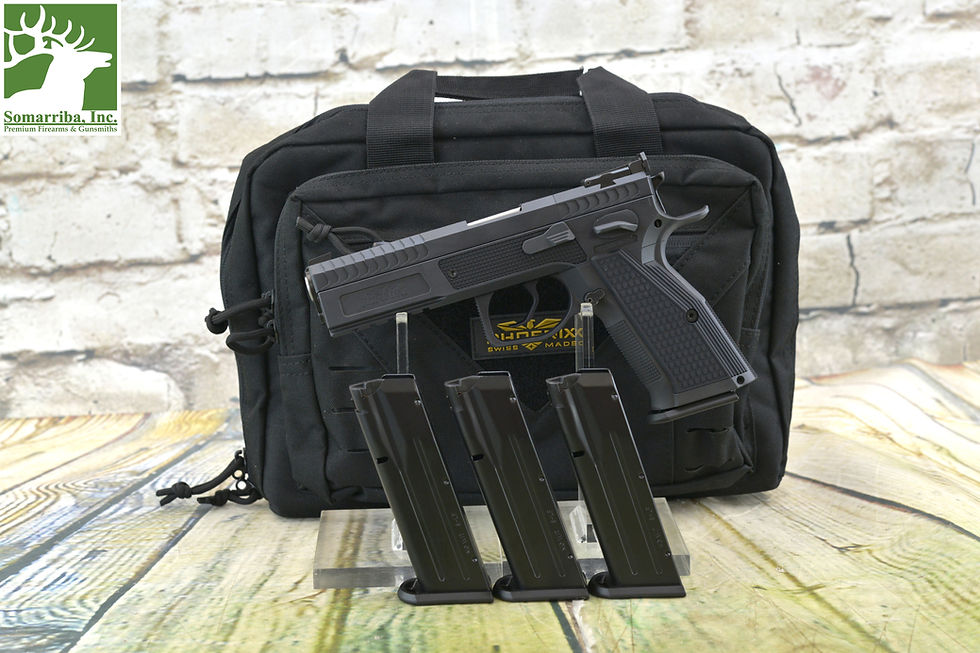
The ambidextrous manual safety doubles as a thumb rest on the strong-hand side, with a wider lever providing a natural shelf. The modular design system extends to grips, side plates, safety levers, magwell kits, and an optional gas pedal for additional recoil leverage. The Drake ships with four 17-round magazines and is compatible with the broader ecosystem of Phoenix accessories and sight options.
Sight options are extensive. Iron sight configurations include fiber optic front sights in red or green, classic target front sights, and adjustable rear sights in both low-profile Bomar-style and LPA micrometer units. For optics, a quick-change plate system accommodates popular red dots including the Trijicon SRO, Shield RMS, and Sightmark Mini Shot M-Spec. The system allows transitions between irons and optics without losing zero, a feature that matters significantly for shooters who compete in multiple divisions.
The black finish on this configuration is applied throughout, and the overall weight with an empty magazine sits in the neighborhood of 51 ounces. That is heavy by any measure. It is also entirely intentional. Mass absorbs recoil. Mass steadies the sight picture. Mass, when properly distributed between a heavy frame and a lightened slide, produces the flat, predictable shot-to-shot recovery that competitive shooters spend thousands of dollars chasing through aftermarket modifications on lesser platforms.
Who This Is For
The Drake is a competition pistol. It does not apologize for this. It is not a carry gun. It is not a nightstand gun. It is not trying to be versatile in the way that a do-everything service pistol is versatile. It is versatile in the way that a serious competitor needs: adaptable across divisions through its modular sight system and configurable controls, while remaining mechanically optimized for the singular task of putting rounds on target as fast and as accurately as humanly possible.
The crossover capability between Production, Production Optics, and Standard Minor means a single Drake can follow a shooter across disciplines without requiring a second gun. That is a meaningful practical advantage for the multi-division competitor, and the modular design makes the transitions quick enough to be worthwhile rather than theoretical.
For the shooter stepping up from a CZ Shadow 2, a Tanfoglio Stock III, or even a tuned 2011, the Drake represents the next rung. It occupies the space where factory pistols end and full custom builds begin, except that it arrives from the factory already built to tolerances that most custom shops aspire to.
Final Thoughts
The Phoenix Arms Drake is the product of a company that has spent decades refining a single platform and refuses to stop. The spherical bushing, the hand-fitted slide, the lightened reciprocating mass, the cold hammer forged barrel, the tri-angled trigger geometry, the modular controls, and the sheer mass of the all-steel frame combine into a pistol that is engineered to win matches. It is hand-built in Interlaken by the same Swiss artisans who carried the Sphinx name to its peak, and it arrives in the United States backed by B&T USA's parts and service infrastructure. For the competitive shooter who has exhausted what production-class pistols can offer and wants to know what the Swiss ceiling looks like, the Drake is waiting. Bring your A-game. The pistol already brought its.
PHOENIX ARMS DEALERS
Shop some of Phoenix Arm's most sought after pistols!


Comments